How Data Processing Platforms Work Together: Where Osteo DPE Fits
November 10, 2026

November 10, 2026
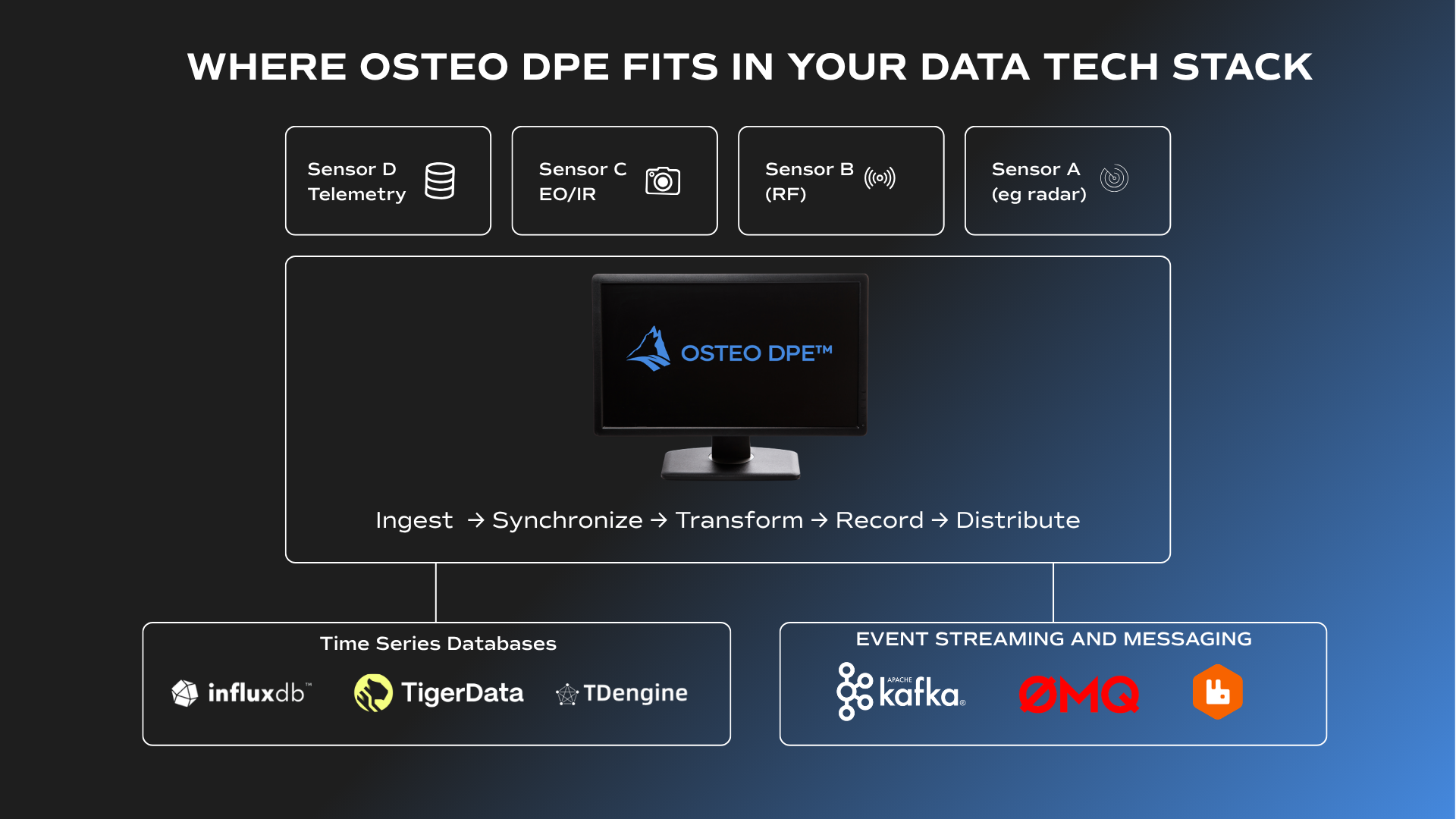
When building a data processing architecture, engineering teams often evaluate technologies like InfluxDB, Kafka, ETL platforms, and custom processing software. But these technologies aren't necessarily competing solutions. In many cases, they're designed to work together.
A time-series database may be ideal for storing and querying telemetry. An event streaming platform can distribute information between applications. An ETL platform can transform and integrate data for downstream systems.
But what happens when raw sensor data needs to be decoded, synchronized, normalized, or processed before it reaches those technologies?
That's where an engineering data processing platform like Necara's Osteo DPE™ fits.
Understanding how Osteo can complement these technologies will help engineering teams design more effective architectures, reduce unnecessary custom development, and get more value from the platforms they already use.
Let's look at the different types of data processing platforms and where each fits into the modern engineering data stack.
At its simplest, an engineering data architecture might look something like:
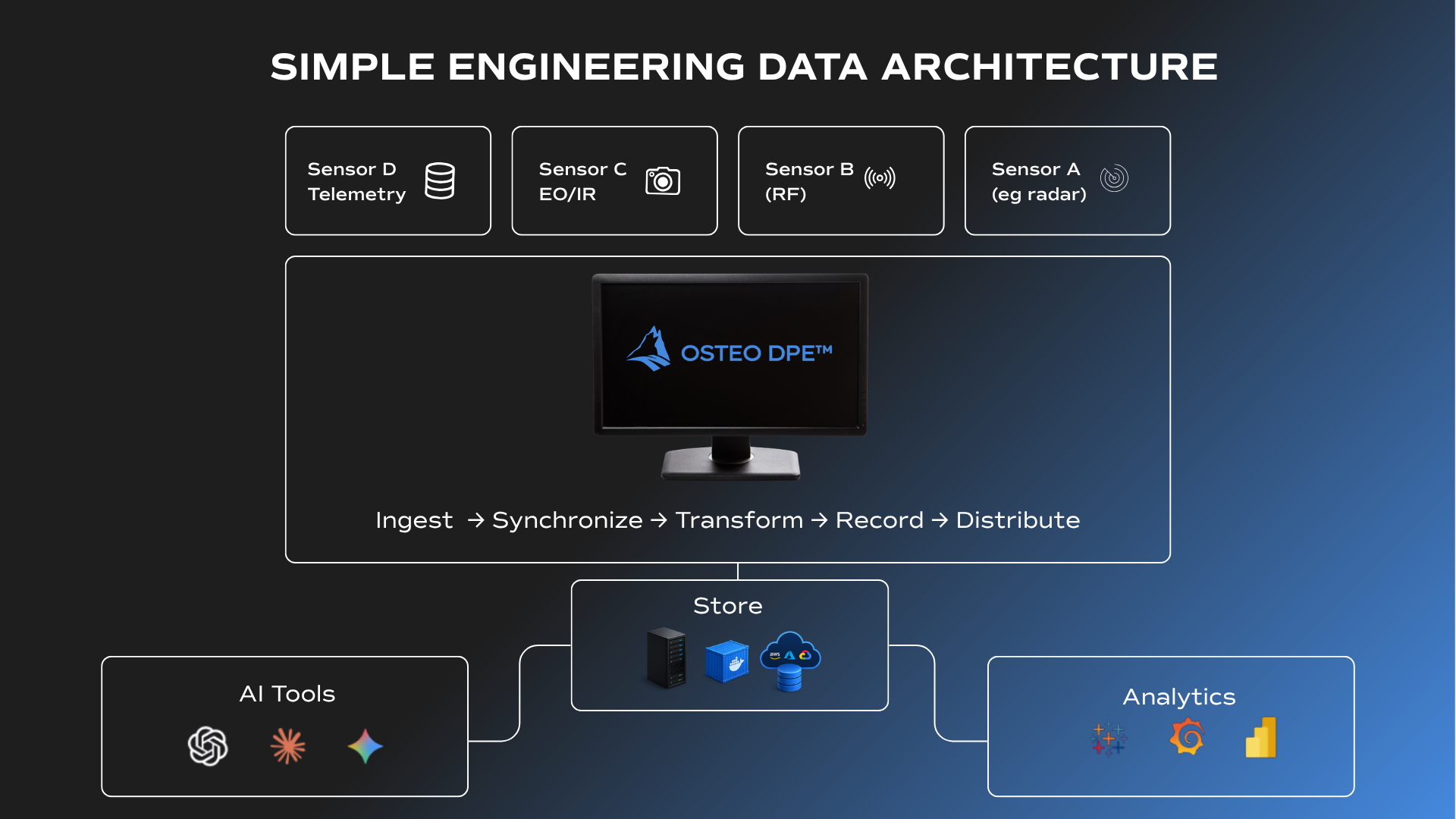
Real-world architectures are rarely that linear. Data may move through multiple processing stages, databases, networks, message brokers, applications, and compute environments.
But thinking in layers helps clarify an important distinction. Some technologies are optimized to store data, some are designed to move it, some specialize in transforming enterprise data. Others process raw engineering data closer to its source.
And increasingly, engineering architectures combine several of these technologies rather than relying on a single platform to do everything.
Here are some of the major categories.
Time-series databases are designed to store and query information associated with timestamps.
They are particularly useful for:
InfluxDB is one well-known example of a time-series database, but it represents a broader category of technologies designed specifically for working with measurements over time.
For engineering systems generating large volumes of timestamped information, these databases provide an efficient way to store, query, aggregate, and analyze that data.
However, the database typically isn't responsible for everything that needs to happen before the information reaches storage.
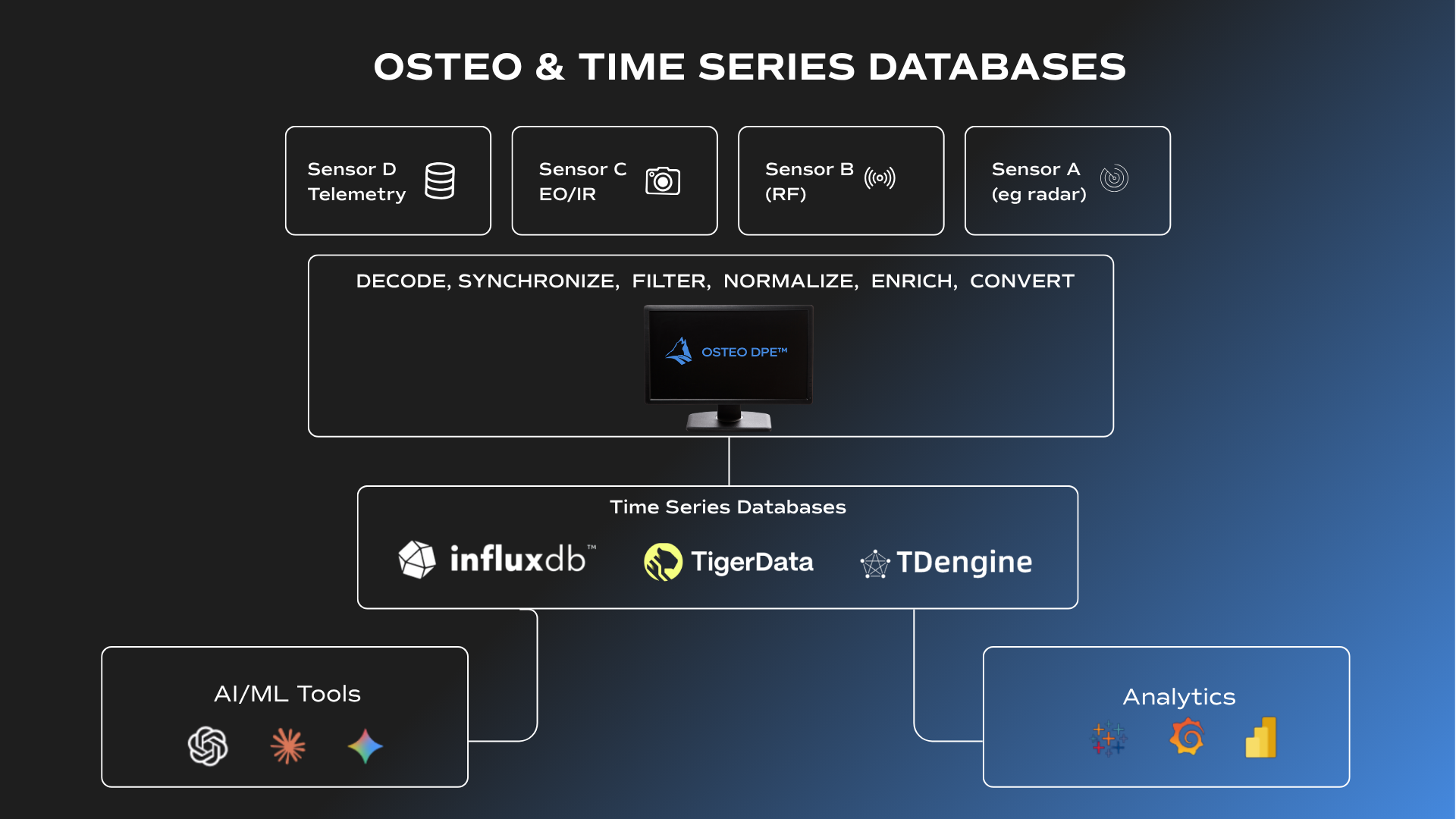
Incoming engineering data may first need to be decoded, synchronized, filtered, normalized, enriched, or converted into a format the database can consume.
That processing often happens somewhere else in the architecture and is where a tool like Necara’s Osteo Data Processing Engine™ (DPE) comes into play.
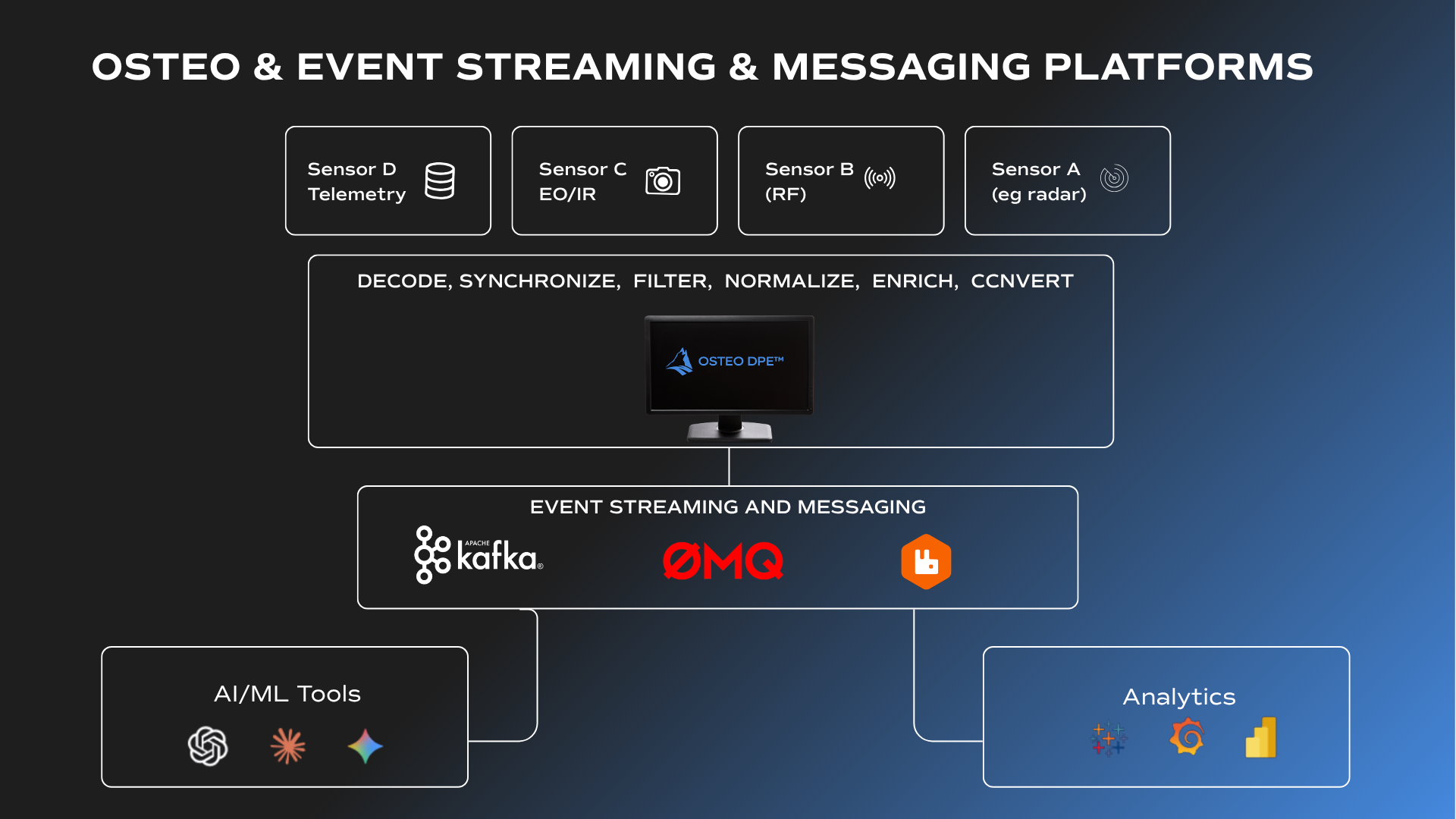
Event streaming and messaging platforms are designed to move information between systems, applications, and services.
Apache Kafka, ZeroMQ and RabbitMQ are some widely used examples. Other messaging and streaming technologies provide similar capabilities for publishing, subscribing to, buffering, and distributing data across an architecture.
These platforms are particularly useful when multiple systems need access to the same information.
For example:
Data Sources → Processing → Event Streaming → Multiple Applications
One application might monitor system health. Another might perform analytics. Another might archive the information. Another might feed an AI model.
The event streaming layer helps distribute that information reliably and at scale. But moving data isn't necessarily the same as understanding or processing it.
If incoming information is encoded in proprietary formats, contains multiple timing sources, or requires engineering calculations before it can be consumed, another layer may still be needed to prepare that data, something Osteo DPE was built to do.
ETL (Extract, Transform, Load) and data integration platforms move, transform, and prepare data from multiple sources for downstream systems. They're commonly used to connect databases, business applications, data warehouses, cloud environments, and analytics platforms.
Platforms such as Fivetran, Confluent, and Striim are examples within this broad category, supporting workflows ranging from traditional batch processing to real-time data integration.
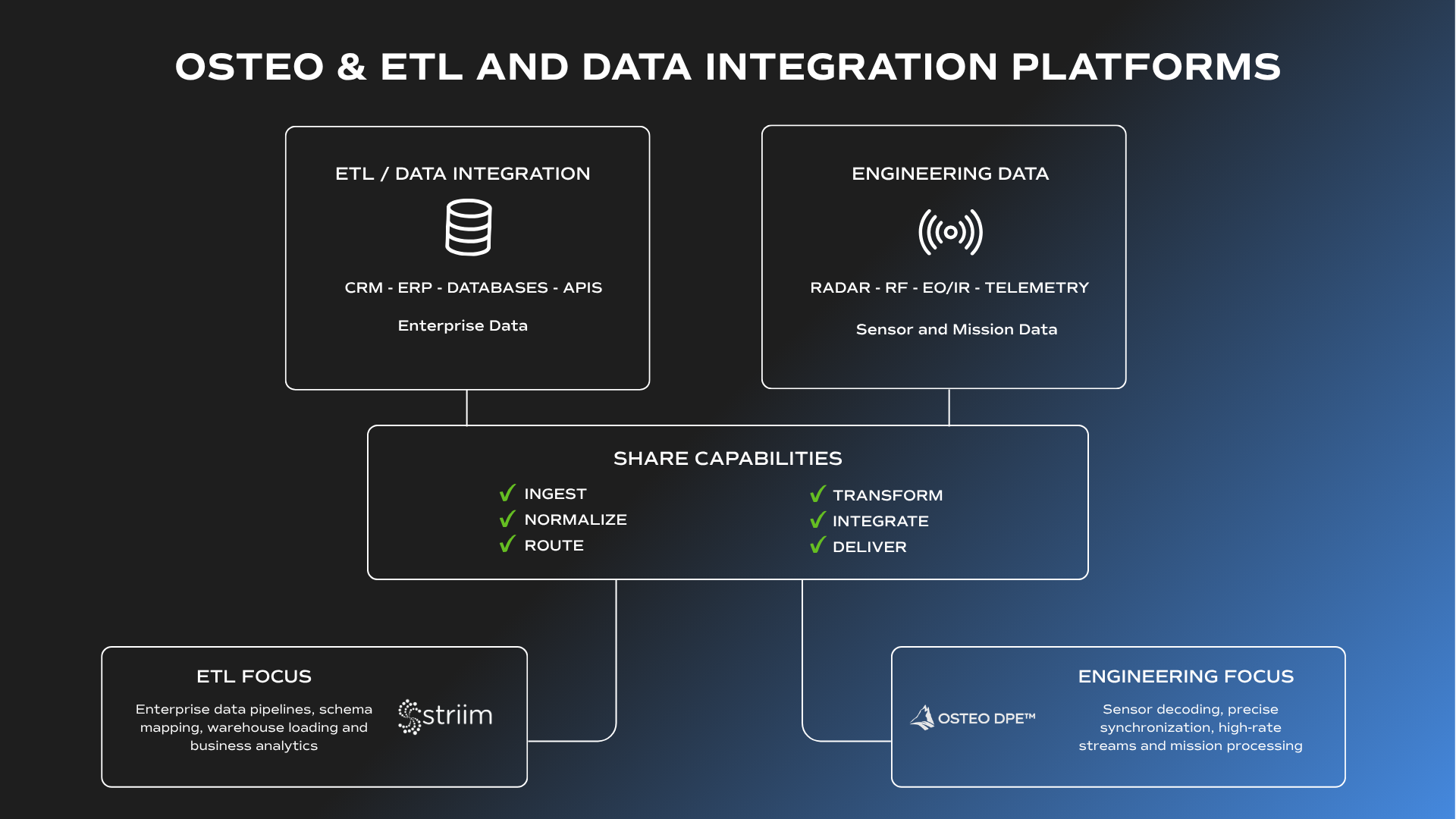
ETL and engineering data processing platforms share foundational capabilities, including ingestion, transformation, normalization, and distribution. The distinction is often in the types of data and operating requirements they're designed to support.
Engineering environments may involve specialized binary or proprietary sensor formats, precise synchronization across multiple data streams, high-throughput processing, and deployment at the edge or onboard mission systems.
Engineering data processing platforms such as Osteo DPE™ are designed to address these requirements, providing a configurable processing layer for complex sensor and mission data.
Depending on the architecture, ETL and engineering data processing platforms can complement one another.
Application integration platforms focus on connecting software systems and automating the movement of information between them.
These tools are useful when organizations need to connect APIs, SaaS applications, databases, cloud services, or business workflows.
A typical architecture might look something like:
CRM → Integration Platform → ERP → Analytics
These platforms can eliminate a significant amount of custom integration work between applications. But application integration is different from processing raw engineering data.
Connecting two APIs is a fundamentally different problem from ingesting a high-rate sensor stream, decoding a proprietary protocol, synchronizing multiple sources, performing calculations, and maintaining metadata throughout the process.
The distinction comes down to where the platform operates and what kind of data it was designed to handle.
Engineering data processing platforms operate closer to the data source. They provide the processing infrastructure needed between sensors, instruments, systems, and the applications or platforms that ultimately consume their data.
Depending on the environment, that can include:
This becomes particularly important in environments involving telemetry, sensor fusion, test systems, mission data, video, RF, radar, EO/IR, or other heterogeneous engineering data.
Instead of creating a separate application around every new data source, engineering teams can use a common processing framework and extend it as sensors, applications, and requirements change.
Necara Solutions' Osteo Data Processing Engine (DPE)™ is one example of this type of platform.
Osteo provides a configurable processing layer that can ingest data from multiple sources, process and normalize it, preserve timing and context, and distribute it to databases, analytics platforms, applications, AI/ML workflows, or other downstream systems.
That means a time-series database, event streaming platform, and engineering data processing platform can all exist within the same architecture while performing very different jobs.
Not every organization uses an off-the-shelf platform. Engineering teams frequently build their own data processing infrastructure, particularly when systems have highly specialized requirements.
Custom development provides maximum control over architecture, interfaces, performance, and functionality. And sometimes that is exactly what the mission requires.
The tradeoff is the engineering effort required not only to build the system, but also to maintain and extend it.
As new sensors, formats, protocols, applications, and missions are introduced, teams may find themselves repeatedly rebuilding foundational capabilities such as ingestion, synchronization, recording, transformation, and distribution.
That makes build versus buy less useful as a binary question. For many engineering organizations, the better question is: “What should we build, what should we buy, and where should we combine the two?”
Mission-specific algorithms, applications, and intellectual property may make sense to develop internally, while reusable processing infrastructure can provide the foundation underneath them.
One of the biggest misconceptions about the data processing landscape is that organizations need to select one platform to handle everything. In practice, modern architectures often combine multiple technologies.
For example:
Sensors → Engineering Processing → Event Streaming → Applications
Or:
Telemetry → Engineering Processing → Time-Series Database → Analytics
Or:
Multiple Sensors → Engineering Processing → Event Streaming → Storage + AI/ML + Mission Applications
Each layer serves a different purpose. The engineering processing layer prepares and contextualizes the data. The streaming layer distributes it. The database stores and queries it. Analytics and AI platforms extract insights from it. Mission applications ultimately put the information to use.
The architecture works because each technology is being used for the problem it was designed to solve.
ed an engineering data processing layer before the data ever reaches those other systems.
There isn't one universal “data processing platform” because there isn't one universal data problem.
InfluxDB, Kafka, ETL tools, integration platforms, engineering data processing platforms, and custom software can all play important roles. The question is where each belongs.
For engineering teams, the goal is to build an architecture that lets each layer do what it does best while avoiding unnecessary custom infrastructure.
At Necara Solutions, we developed Osteo DPE™ to provide a flexible, reusable processing foundation for complex engineering data. By simplifying how teams ingest, synchronize, transform, and distribute data across systems, Osteo allows engineers to focus less on building infrastructure and more on the capabilities that differentiate their missions.
Building a data processing architecture? Let's talk about how Necara Solutions can help with integration and how where Osteo could fit into your stack.