What Is Multi-Mission Data Processing?
.png)
September 9, 2026
.png)
September 9, 2026
Multi-mission data processing is the ability to support different missions, platforms, and collection capabilities through a common data processing environment.
Those missions don't necessarily have to look alike.
One might involve an on-orbit Earth observation platform collecting imagery. Another could involve an airborne sensor generating streaming data. A third might combine telemetry, RF, radar, video, or other mission data.
The requirements can be completely different. Connectivity can be different. The resulting data products can be different. Even the underlying technology stacks can be different.
That diversity is precisely what makes multi-mission architecture difficult.
As Dirv, CTO & President of Necara Solutions, explained in a recent discussion, traditional systems are often designed around one mission's requirements and one mission's data.
Supporting an entirely different type of asset with the same underlying engine requires a fundamentally more flexible approach.
The goal isn't to make every mission operate the same way. It's to create enough common infrastructure that every mission doesn't have to start from zero and all the data can be aggregated to one visual dashboard.
The aerospace and defense industry is increasingly talking about multi-mission operations. But supporting multiple missions isn't simply a matter of connecting another satellite, sensor, or platform to an existing system.
The underlying challenge is architectural.
For decades, mission software has largely been built around the requirements of a specific program. A satellite mission gets its own ground system. An airborne collection platform gets another. A new sensor, payload, or program may introduce its own data formats, interfaces, workflows, and processing requirements.
That approach makes sense when you're optimizing for a single mission. It becomes increasingly difficult to sustain when organizations need to operate across many missions at once.
As constellations grow, sensors proliferate, and missions become more interconnected, aerospace and defense organizations are being forced to ask a different question:
How do we build data infrastructure that can support the mission we have today without rebuilding it for the mission we launch tomorrow?
One of the biggest barriers to multi-mission operations is also one of the most understandable: aerospace systems tend to be purpose-built.
When a new program begins, a team builds technology around the mission requirements in front of them. The software works. The mission launches. Over time, workflows, integrations, interfaces, and institutional knowledge develop around that particular environment.
Then another mission begins.
Its requirements are different, so another system is built.
Eventually an organization may find itself supporting multiple highly capable systems that were never designed to communicate with one another.
These environments can become highly stovepiped. There are efforts underway across the industry to reduce those stovepipes, but the level of success varies considerably by organization.
And the problem compounds over time.
Every new mission potentially adds another architecture to maintain, another set of integrations to support, another workflow operators must learn, and another environment engineering teams need to understand.
What worked as mission optimization can gradually become organizational complexity.
In many cases, they aren't intentionally trying to. It's the natural result of building around individual mission requirements. And now, companies are leaning heavily on AI to build mission architecture.
An airborne collection platform and an on-orbit platform may have completely different connectivity constraints. They may generate different data products at different rates. They may require different processing workflows or operate in environments with very different computing resources.
Building specifically for those requirements can be the fastest way to get the first mission operational.
The problem appears later.
When another mission requires similar capabilities—data ingestion, processing, recording, transformation, distribution or integration—the organization may discover that much of the previous engineering work isn't easily reusable.
The result is another custom implementation of a problem the organization has, in some form, already solved.
Over enough missions, this can create a collection of systems performing many of the same fundamental data-processing functions in entirely different ways. It starts to become difficult to track and costly from a resource standpoint.
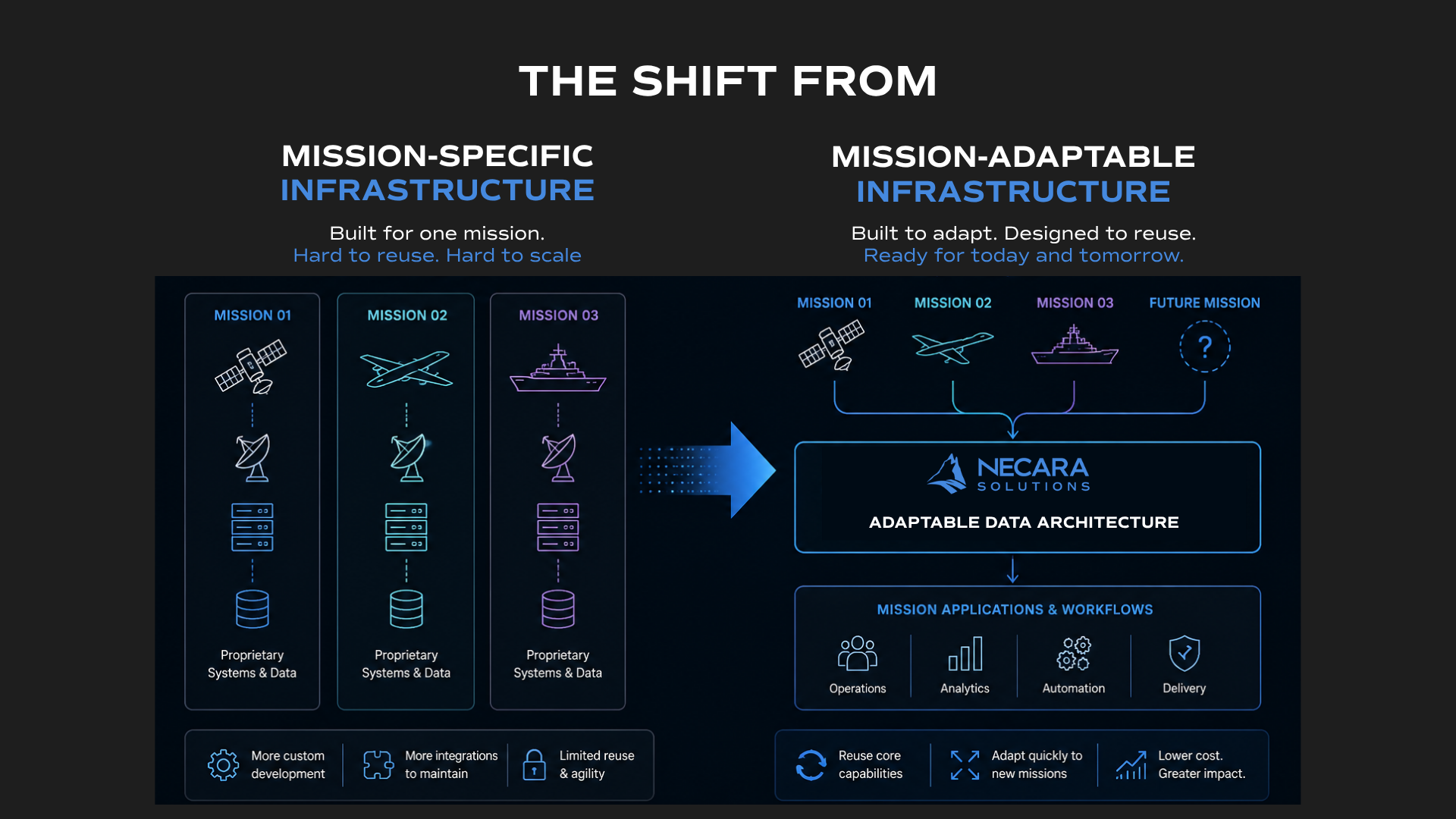
It's tempting to think about multi-mission integration primarily as a format-conversion problem.
One system produces telemetry. Another produces imagery. Another produces RF data. Normalize those formats and the problem is solved.
In practice, the challenge goes much deeper.
Different missions can have different data models, timing requirements, interfaces, processing workflows and connectivity. Some systems may stream continuously, while others process files or recorded data. Some processing may happen on the platform, some at the edge, and some within a ground environment.
The architecture therefore needs to accommodate these differences without requiring an entirely new processing system every time one variable changes.
This is where the distinction between mission-specific software and a multi-mission data processing platform becomes important.
A multi-mission platform isn't necessarily trying to eliminate specialized mission applications. Instead, it can provide a reusable processing layer underneath them.
Individual missions remain different while sharing common capabilities for ingesting, transforming, processing, recording, and distributing data.
Potentially, but doing so requires the ground architecture to be designed for differences between missions rather than around the assumptions of one mission.
A traditional ground system may be tightly coupled to a particular spacecraft, payload, data format, or workflow. That makes the system highly effective for its intended mission but potentially difficult to adapt when the next spacecraft or sensor behaves differently.
A multi-mission approach separates more of the underlying data-processing infrastructure from the mission-specific components.
Instead of rebuilding the entire processing environment, teams can introduce the interfaces, processing components, or workflows required for the new mission while retaining common infrastructure.
That doesn't mean every mission suddenly shares one identical ground system. Rather, common capabilities can be reused and deployed where they're needed.
Multi-mission is as much an organizational challenge as it is a technical one.
When every mission uses a different technology stack, operators and engineers become specialists in individual systems. Moving someone from one program to another can mean learning a completely new environment.
The same problem appears at the contractor level.
A program may be built around one prime contractor's tools and workflows. A later mission may use a different spacecraft bus, sensor provider, prime, or software environment. Suddenly much of the infrastructure and institutional knowledge developed for the previous mission doesn't transfer cleanly.
A common processing architecture can change that dynamic.
If multiple missions share parts of the same underlying environment, people don't necessarily have to relearn the entire system every time they move between programs. New capabilities can also be introduced without forcing the organization to abandon everything that came before.
In other words, multi-mission architecture can create portability not only for data, but for workflows and knowledge.
Building software around individual programs can also result in technology that becomes closely coupled to the contractor or platform selected for that mission.
That may not seem problematic during the initial program. It becomes more significant when the next mission needs something different.
Perhaps an organization selects a different spacecraft bus. Perhaps it introduces a new sensor. Perhaps another contractor wins the next program.
If the data infrastructure is tightly coupled to the previous environment, changing one component can trigger a much larger technology change.
A vendor-agnostic processing layer provides another option.
Rather than requiring every platform to use the same hardware, software, or contractor, the organization can establish a common data architecture capable of accommodating different systems.
That makes multi-mission architecture less about standardizing every component and more about establishing a common foundation between them.
There probably isn't one architecture that will work for every aerospace and defense organization.
That's partly the point.
A useful multi-mission environment needs to accept that missions will continue to have different requirements.
The architecture therefore has to be modular enough to support new data sources, adaptable enough to work across different deployment environments, and open enough to integrate with technologies that haven't been selected yet.
It also needs to address the underlying capabilities that missions repeatedly require: ingesting data from diverse sources, processing both streaming and recorded data, preserving timing, transforming data between formats, recording and replaying mission data, and distributing that data to downstream systems.
Some processing may happen close to an individual mission. Other capabilities may operate across missions, allowing data or workflows to move between systems. Organizations may also need to deploy the same processing capabilities in different locations depending on bandwidth, latency, security, and operational requirements.
The common layer provides continuity while the mission-specific pieces continue to evolve.
This is ultimately the architectural shift multi-mission data processing is trying to enable.
Rather than building separate processing engines for every program, organizations can establish reusable data-processing capabilities and extend them as new missions come online.
Necara's Osteo Data Processing Engine and Osteo Orchestrator were designed around this type of model.
Osteo can operate within individual mission environments or serve as a processing layer across them through Osteo Orchestrator. That means an organization could deploy Osteo in support of individual missions while maintaining a more consistent processing architecture between those missions.
The larger objective isn't simply software reuse. It's architectural reuse.
That distinction matters because the next mission will almost certainly be different from the last one. The goal isn't to predict every future requirement. It's to create an architecture capable of adapting when those requirements arrive.
Aerospace and defense aren't becoming less complex.
More satellites are being launched. More sensors are being deployed. More data is being collected. Space, air, ground, and maritime systems are becoming increasingly connected.
At the same time, organizations are looking toward more sophisticated data fusion, multi-phenomenology, AI-enabled analysis, and cross-domain operations.
Those capabilities depend on being able to access and work with data across systems that weren't necessarily designed together.
Continuing to build an entirely new data architecture around every mission becomes harder to justify in that environment.
The better question may no longer be:
What software do we need to build for this mission?
It may be:
What infrastructure can we build once, extend for this mission, and continue using for the missions that come next?
That shift is ultimately what multi-mission data processing is about.